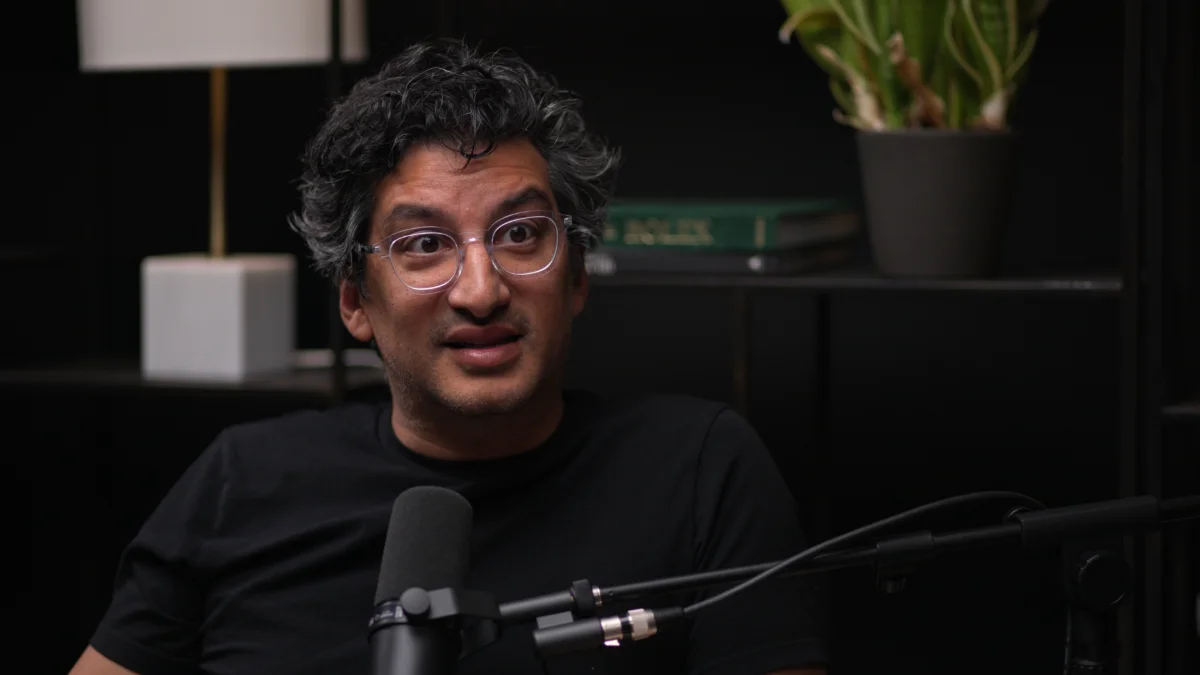
Som Seif, CEO of Purpose Unlimited and co-founder of Wealthsimple, joins the StartWell Podcast to talk about why Canadians fear criticism more than failure, how small businesses struggle to get capital, and why AI is the most exciting moment of his career.
Som Seif, founder and CEO of Purpose Unlimited, joins the StartWell Podcast for a wide-ranging conversation about entrepreneurship, personal finance and financial services. He draws on a career that began at RBC, included founding Claymore, one of Canada's early ETF companies, and extended to co-founding Wealthsimple and leading Purpose Unlimited.
Seif argues that Canadians are not less talented or less capable than Americans. He says the difference lies in how failure is treated, and he makes the case for building a culture that celebrates builders. On money, he suggests that investing in your own skills and earning power matters more than trying to beat the markets. He also explains why banks struggle to serve small businesses and how Driven, Purpose's SMB financing arm, tries to close that gap.
Why fear of criticism holds back Canadian founders
Betting on yourself and treating investing as a background system
Why advisors should help clients reach life goals
How small businesses are underserved by large banks
Keeping a founder's culture intact as a company grows
Using AI to rethink the work a company does from first principles
“It's a fear of criticism.”
“99% of the time of your career, you should be focusing on what makes you more successful, not worrying about investing in markets and all the rest of it.”
“Giving someone a loan for less than a million dollars is actually unprofitable.”
“it's the doer that ultimately would get rewarded in these moments.”
Hi, my name is Sam Safe. I'm founder and CEO of Purpose Unlimited and been building a business and financial services for a long time and innovating on behalf of Canadians. Purpose is an ecosystem that basically supports Canadians with financial products like investment management, wealth management and infrastructure, ultimately helping Canadians achieve their goals and long-term outcomes. Today on the Start Wealth podcast, we're going to talk a lot about the changes in financial services that are happening and why they're important. We're going to talk a little bit about the founder's mindset. We're also going to talk a little bit about the importance as individuals to be willing to fail to ultimately succeed.
Well, first off, thanks for coming by. Yeah, great. It's awesome to have you in the studio and here at Start Wealth for the first time ever. Yeah. And it's always nice to- It's a great experience looking around and seeing what you've built here. It's really- Thanks. ... quite nice. Thank you. Yeah, it's my Taj Mahal. Which is weird to say as a renter. Yeah, no, it's been quite the journey and it's a journey that's yielded so much insight even personally, even though I've been a lifelong entrepreneur across continents and been in so many industries. What I have learned to be able to bring back to recommend to people is phenomenal and it's ever increasing. That's the thing about learning. A lifelong learner keeps learning.
But specifically, I think the note in the last six, seven years that's been the four note has been about resilience and how no matter who I talk to and whoever we bring on the Start Wealth podcast as customers, partners, ecosystem people, everyone's been touching on this issue, especially when it comes to entrepreneurialism in Canada. The idea that the get rich quick vibe in the startup ecosystem at least in the last decade that maybe was inherited by, I don't know, fast money on the early stage venture side has gone through a correction curve lately or is going through a correction curve. But it's kind of brought up this question that a lot of people seem to be asking and more people than I thought are actually working on answering, which is how do we develop resilience amongst Canadians, young Canadians, to the point of not just encouraging fearlessness, but encouraging a kind of antifragile mindset. So people aren't afraid of failure so much that they don't actually build anything. Yeah.
I mean, there's a lot to unpack in that. And there's a couple of components which I think I'm very passionate about and important that we have to acknowledge as Canadians. So people first starting point is Canadians are viewed as safer. They're less risk taking. And I think it's somewhat silly. We have all the same quality of talent, same quality of intelligence, great ideas. We have theoretically capital, but that's a different problem. What we have to overcome is this fear of failure. And it's actually a proven difference between Canadians and the United States.
And Americans, they have this willingness to call it experiment, to drive, to push themselves. And the reason why I believe that that's the case is because they celebrate entrepreneurship. They celebrate founders. They celebrate people who take bets and bet on themselves or bet on an idea. But the second component of that is they also don't criticize people for failure, for trying. And that is really important. Actually, in many ways in the United States, they will celebrate someone who failed once and then figured it out or pivoted the turnaround story, the comeback story.
In Canada, it's very different. When somebody fails, it's criticized. How could they have done that? Oh, that person's awful. And so that fear isn't a fear of failure in many ways in Canada. It's a fear of criticism. And the challenge as a Canadian is, how do you overcome that? I think it's hopnash. And I think it's unfortunate about our system. We need to change the narrative and the culture of this country to celebrate those who are builders, celebrate those who are attempting and experimenting and trying to figure things out.
And more importantly, getting the signal sometimes of failure to actually lead to better outcomes. It's a huge opportunity. And if we get that, we can get back to that mindset of a country that can win at a much greater pace than we've had in the past. So I get excited about this. But I look at the statistics of, I think it's fear of failure, not fear of failure individually, it's fear of judgment of failure, which actually hurts Canadians. And you know what? Unfortunately, between the media, between the population, populists and all of a sudden, we have this feeling that it's a one and done. If you don't make it the first time, you're done. And I just think that's terrible. It is terrible, especially as, I mean, we're talking in 2026, it's a highly volatile, you know, I mean, you're probably going to give me more qualitative kind of, you know, perspective on this. But from where I sit, I think there's so much in flux in terms of how technology is evolving to push the need for change in so many industries, right? Whether that means people are going to lose their jobs or whether it simply means that people now have superpowers if they want to use them. So they have to rise to the challenge, you know, and that kind of a thing.
But there's so much potentiality and there's so much also, I would say we've seen a shift in the last couple of years or the last few months, really, especially in Canada, in how Canadians are questioning their role in the world, you know. And so with all that, you know, being our milieu currently today, it's really interesting that like we aren't readdressing this fear of failure more
because we can't like navel gaze anymore, you know, and there are foreign markets that are at our fingertips. Yeah. And look, I think one of the greatest things to come out of the last year or so is a kick in the ass, a wake up call for not only Canada, but many developed countries around the world who had sort of become complacent, complacent in the world that we had. And I think, you know, Prime Minister Mark Carney talked about this at his Davos speech. And I thought it was a wonderful message, which is it's time to actually really take ownership of our own destiny. And I think that's not just at the country level, but it's at the individual level as well. You know, with technology, with AI, ultimately evolving as it is, you know, whether you're an individual, thinking about your world, your sort of role in the future and where is my value proposition in a place where technology could be disrupting my job in such a meaningful way and automating so much of what I kind of known as the job I was doing all the way to an organization who, you know, whenever you go through these transformational technology shifts, you know, whether it's the internet, whether it's AI, that ultimately changes the way an organization has to think about the job that they're doing and how they can deliver that service and value to the, to the market that they're dealing with it. You know, there's a huge opportunity to kind of go back to first principles to rethink this. And if you think about this as going back to what we first talked about, the founder's mindset, the founder, the individual who is the bold thinker, the bold principle doer, you know, you have to have that kind of DNA in you and these moments, which is, and every organization, every individual has to go back to it, which is what are the first principles of the thing that I do? What is the first principles of the job that I'm trying to solve for, whether it's an individual or corporation? And then ultimately, how do I go back to doing that in, in with this new information, new, new flow of information, data, technology, whatever it be that allows me to do it in a maybe better way? Yeah. I think it's a powerful moment. And, you know, that kick in the ass complacency, a lack of complacency is actually a really great thing for us in these moments to kind of say, we can either sit here and, you know, oh, duck my head in the sand as a country, as a company, as companies or as individuals, or we can do something about it. And it's the doer that ultimately would get rewarded in these moments.
I think so. And I think also it's like, it's a, it's a good prompt for us internally in this country to look at each other and say, how can we work together? Yes. Because unfortunately, I feel like part of this fear of failure has been, I think, dogma that's either subconscious or inherited generationally, you know, to accept monopolies and to be able to somehow also, it's a binary logic thing, but like to default into this David and Goliath complex, if you aren't monopolistic in your own dominion of a market. So why do you need to be a challenger? And what's the challenger mindset is something I always ask people because, yeah, in a startup ecosystem, you'll hear this a million times a day. If you're, if you're an investor and people are pitching you is the first thing they're going to say when describing who they are and what their value prop is, is, oh, we're the Uber of this industry. And then it always comes back to this, like, how are you going to disrupt something? Well, that is not necessarily investable, right? Alone. And at the same time, I think, yeah, there's also this idea of like Canadians waking up globally to say, like, if the whole global market is accessible to us, depending on what you do for work, that's glorious because you don't need to be competitive or you don't need to fight for a piece of the pie because the pie is so big, right? And that was that early internet paradigm. And I think that also might frame us now to talk a little bit about your career history.
Yeah. So first off, the word challenger, which you use it to be, it's actually a really important one. Yeah. You know, people assume it's a, you know, you have to be a challenger as a business or whatever it be. And actually the challenger is a great mindset, you know, where it's not the devil's advocate, which is like, I'm going to always tell you the other side of something, but I'm going to actually challenge our thinking to improve on, on the foundations of where we are. So it's the idea that you have an idea I can push and challenge you to maybe improve on the idea. So together we collectively get a better outcome. That is what I love. It's a progressive type of ideation iteration to get to a better outcome. And whether that's a industry participant who is pushing, you know, incumbents to think harder, think deeper about the job that they're doing, how to serve their customers, to be a better organization, to be a better operating company, whatever it be. And those are really amazing challengers. Or if it's an individual in the organization who is ultimately willing to push us to think better and push us deeper to go, not just to the surface level thinking, but to a much deeper level of thinking that can get us to a better outcome. That is a wonderful place to be. And everyone has this talent and capability.
It's just a question of whether you sign up to be that person. Yeah. And so I think we sometimes look at challengers and we say, oh, they've got to be off to the side and doing something. I actually think challenges have to be at the core. It's really powerful. You know, look, I just, I get so excited. Like humans, we are, we have such capabilities. We've seen it in all of the history arc of time that like when something new comes at us, when something pushes us, we adapt, we win, and we find ways to be better and stronger. And I just think this is an awesome thing. And I started to take this period of like AI disruption and the fear of it. And I look at it and say, why are people so fearful? They should be so inspired. It's just unknown. It's, I think it's that classic, like you don't know enough of, it's, it does, it feels foreign to people. But I think that, so one of the things I've felt in my strength as an individual is that, you know, I can actually sit in the unknown or the gray and actually say, I'm comfortable there. I can, I can operate there. I think people have to get more comfortable operating in the gray a little bit more, not with black and white, which is you are either this way or that way, which is that we could actually take this unknown and maybe mold it the way that we think it should be or the way we want it to be. We have actually uncertainty means that there's an opportunity to fix or get to the better outcome as opposed to the way it's been done by somebody else or taking somebody else's future. And so I love this. Like I operate in the gray really well. And I think others should learn how to operate in the great well. And it's like status quo now, man, or increasingly so.
Yeah. You know, the gray, we live in the gray. And I think it's interesting because it kind of like plays into that whole challenger mindset thing too. Right. So like if companies are operated in a competitive mindset in that way of like us or them or market share in a finite market that we're trying to somehow steal or win from, you know, the big scary guy who's going to club us. If he looks at us with a cyclops eye. If a company is operated that way, the staff will all feel that they're on a particular mission and there's suddenly all these fear paradigm and expectations and you can't speak up and it's not what a participatory culture. And I think that's where this whole challenge, the real challenger mindset disappears. Right. Well, great organizations learn how to channel the growth mindset in the organization. Like my, my principle is as a intellectually intellectual capital business, where we don't have machinery and factories in our organization, our company is a sum or a, you know, multiplication or a, you know, some kind of derivation of, you know, of the people, the talent, the growth of our people. I always say that. Yeah. And so our greatest value is to have individuals in our organization that are compounding and growing at a fast pace, right?
Because that means that the company is therefore going to grow and has the opportunity to grow at a much faster pace. And so this is a really powerful thing, which is we want our people to constantly be on the edge of uncomfortableness. And on, on, on, and that, if you look at it, you know, great analogy would be look at some of the best athletes in the world. We just finished the Olympics and in the, in the winter here. Yeah. And you look at these athletes and I tell many people at a time, they, to get to the podium or even just get to being at the Olympics, these individuals had to work at a pace where they weren't comfortable.
They weren't happy every day. They actually were very uncomfortable and had days where it was really terrible, really awful, but it had a single purpose, had a goal, had a place they want to do. And it's how you ultimately drive yourself to be at the top. Yeah. And that kind of mindset is what you want broadly in individuals. It's a wonderful mindset. It's, it's constantly push yourself to the edge of uncomfortableness and then let the organization ultimately help drive that. The best person to compete against is yourself, right? Yes.
So be a better person at every stage of the journey and you're going to be fulfilled with the challenge and the, and the journey that you're on. That's right. And so we come to finance. You've been doing this for a while. You've been, you've been in finance for a while. When did you go off on your own to start your self-driven journey? So first of all, I love the financial services industry. Not only does it have a high mission in terms of the impact it has on Canadians and individuals and whatever region they're in, but second is that it actually is a really great industry to operate and innovate within.
So my starting point was actually was an investment banker at RBC. This is post-university, post-university studied engineering, you know, sort of really enjoyed it. But I kind of woke up one day and said, is this the job that I want for the career arc? Wait, how old were you at that? Well, I was 26 when I realized that. But you had like, yeah, I was, I was before the plugs. That's right. I was, you know, I was naive, naive kid. But it was a, it was an amazing moment because I was learning a ton, but I just realized when I stood up and said, who's job do I want when I'm 45? And I couldn't find anybody that inspired me. And so within the organization, within the organization. So I said, you know, I got to do something and I wanted to build. And I didn't know if I wanted to build on my own, if I want to build with others, build for somebody else. I didn't know yet, but I figured I wanted to build. And so ultimately the right idea came out a couple of years later, I was 28. And I left RBC to start my first company called Claymore. And you know, in the financial services business, I didn't know anything about asset management. I'd advised a bunch of asset management companies, but I had a first principles call a perspective of how, what's the job that people ultimately were paying people to do here, which was help them, you know, beat the market. That's what I thought that people wanted. So I started a investment company that really innovated and changed the landscape for investments in Canada. We launched with what we call today exchange traded funds. And back then, no one really understood what those were. And we exchanged traded funds, which are effectively mutual funds that trade on an exchange, but all around a set of principles of low cost, transparency, more tax efficiency, better architecture for how to utilize them in portfolios for individuals or for advisors and institutions.
It was a really great product. And we were one of the first firms in Canada. And of course, you know, one of the first firms in the world being doing this. And it was a really amazing thing. And that business just, you know, grew beyond my wildest dreams in terms of it's my original business plan and then what it ultimately did. But I had a really amazing partner in that firm in the United States called Guggenheim. And at the end of the day, we made a decision to sell the company in 2011, 2012, we closed. And a firm called BlackRock, which is the largest asset management firm in the world, bought the business. Wait, sorry, sorry. What was the period that ran? So 2005 to 2000 and beginning of 2012.
Wild ride. Yeah, that's not very good. Grew from zero to $8 billion in that seven years. It was one of the fastest firms to do back in Canada. Of money managed. Managed for Canadians, exactly. And we at the same time pushed our industry and drove our industry participants, you know, to change the way they operate. And today, much of what that the industry of asset management has been evolved to is actually some of the core principles of what Claymore. So I'm really proud of it. And it actually set a foundational principle in my mind, which was, you know, our job in financial services, you know, there's this kind of, you know, you talked about market share and you talked about pies and this and that earlier, but there is nobody who has market share in financial services.
It's a very fragmented business. Like the largest asset management firm in the world, BlackRock has 6% market share. You know, and then there's a big long tail after that. And so the idea of chasing market share is a misnomer. What I always looked at is, as you want to build a business that ultimately has a set of values and you want to attract people to that values. And then second is you want to lead from the front, they call it the tip of the spear of innovation, so it's that you're setting the bar for the industry on what great looks like. And everyone else catches up. Your success actually as a, if you really want to change the industry is not to do it on your own is to lead change in an industry and force everyone else to say, that's the bar I need to basically be at. So, you know, that's how I sort of have done what I did. And I learned that through my first business and I really hold it in my second and third business. And so, so I left, uh, after the sale of that business and started up a year later purpose, which is the business I'm operating today.
And I had this big grand vision for how call it financial services could go even more modern, not only on the asset management side, but also how do we help change the way wealth management ultimately operates and the technology infrastructure and the mindset there. And within that was also the idea of what ultimately became while simple. And so we ended up, I ended up co-founding law simple. So that came out of the exact purpose. And, um, and so the principle of a purpose and now well, simple as well has always been, how do we help change the direction of how we operate, uh, for Canadians? How do we make Canadians better off, not just because we're launching investment product or investment. It's not cause you want to sell more stuff to them.
It's building part of it. It's by it's recognizing that you have to build a system. Yeah. It's a system of how someone succeeds as an individual in ultimately achieving their long-term goals. And that's ultimately, there's a set of things that need to happen. And you know, you need to build to allow someone or to enable somebody to be great at ultimately compounding their wealth, saving and ultimately getting to retirement with confidence. And so that's something we've always been building towards is understanding the client, the challenges they're faced, what they need ultimately from our industry, and then innovating, uh, the solutions and services around that to help them within that system. And there's a lot that you're doing now from what I understand. So what like purpose, if you're, if you're to save like purposes, service offering breaks into categories, what is it? Yeah.
So we have sort of three key areas. The first is, um, you know, when you look at the problem and individual needs, they need a layer of advice and they need support. And so there's advisors and support there. That's going to be coming out. Talk about it in a second. The second is you need, um, infrastructure, like the systems of how you actually open an account, have an account manager, the reporting, the, all the efficient infrastructure that's required there. And then third is you actually need great asset management capabilities to actually access the return streams that are required. And so what we've done is we've been optimizing to all three of those layers. We at purpose, we've done them in fragmented ways so that someone can access any component, the asset management, the infrastructure or the wealth services altogether or separate at the well, simple it's all integrated. So it's all in an integrated way, but the principle of purpose and well, simple always based on that same DNA, that principle mindset that, you know, this ecosystem, that system has to work together and being built on great technology, infrastructure, and call it capabilities is what ultimately allows it to succeed. What purpose is ultimately today is we, we run asset management products that anyone can buy, uh, as well as integrated into a infrastructure and a wealth infrastructure to support advice, great advice. And then on top of that, we also have advisors that support, uh, end clients with the whole human advice.
Yeah. And so the whole business is built on technology and infrastructure and, and great call it core systems, but at the same time, it's all about serving that end customer with great outcome. Okay. So I want to go meta for a second, right? Cause you've had deep experience in this financial services industry. In fact, let's rewind before we go, man. Did you want to like, you know, when like people ask kids, Hey, what do you want to be when you grow up? And most of the time they're looking for an answer, uh, paired with a toy they can buy for their birthday. Um, but for the most part, you know, if you reframe the question, people have ideas, kids have ideas, at least my eight year old does, you know, lots of cool ideas about what she can do and what our capabilities are. When you were a kid, did you have a, uh, an interest in? Yeah, I always wanted to be, uh, a basically when I was young, that young, I wanted to be a car designer. Uh, and then I wanted to be an architect and that was my core thing. And it's actually really fascinating because I chose not to go into architecture. I went to engineering instead because when I went to spoke to a bunch of architects, uh, you know, just before I was applying and going through the decisions, um, you know, a lot of them told me not to do it. And they told me all of the reasons why, what I thought I wanted from it would never actually be what I would be doing. And you know, it kind of deterred me. So I went into engineering and that is never looked back. But, but when I've actually gone and call it gone back to why did I want to be an architect, what was it that inspired me about building, uh, you know, systems or design or whatever one, I love my creative mind.
But second was, I love the idea of seeing the things that you had come up with and developed actually come to fruition. Yeah. The manifestation progress of ideas. Right. And so architecture is the simplest linear way to think about that, where it's just you build it, you design something and it ends up in front of you, right? A car or design, you know, you design something and it ends up on the road, right? What, what ultimately was, if I go back to it as a human, it was always around this idea of progress of ideas.
Right. And so how I've applied that to is in, in my, in my career is I've always been the kind of person who says like, I've got creative ideas. I've got ideas I want to pursue. I've got that first principles mindset of how do I iterate and develop even better ideas. And then I love to see inaction executed and in market. And so that's what I've constantly been doing. And that's where, you know, I've always wanted my career and, and the creative juices, the creative ideas that come from that are, have been driving me in my execution. It's so interesting. Yeah. I, when I was a kid, I, I loved, I loved like technical pencils and doing 2d floor plans and just like visualizing the space because I could do the 3d walkthrough in my brain. I know. And, and I was going to be an architect and I did the same thing. I went, I think it was Miguel. I might've gone to the architecture school and I asked a bunch of people and profs and stuff. And they were like, yeah, you'll be designing backend systems and interior of the building. Yeah.
And you would like how an elevator can move and you you'll hate yourself. And it's all math. It's not fun. And there's no money in it. No one's going to pay you for it. Yeah. And you add all of that together and you're just like, why am I going to this? It's funny. Just last week, I was talking to a friend whose son went through this as well. And they said that they went and talked to a bunch of architects and they're still saying the same thing, you know, but my mom gave me great advice at the time. And she said to me, you know, some, if, if you're, if you're successful in any role, you can find ways to make it successful, what you want. Great.
And I never really listened to it at the time as we should always listen to our moms a little more. But reality is, is that she's right. You know, if you, if you're passionate and you're good at what you do, you can always find ways to make money and do the things that you actually love with it. And, you know, I think that we shouldn't be deterred, but at the end of the day, I'm not crying for the fact that I didn't do it, but I look back and say, you know, that was the foundational principles that I always had in me that I cared about, which is I love, I love building. I love doing, I love seeing things through fruition. I love executing. I love seeing the ideas that we've developed go and actually make a change in the people's lives that we impact. So, and it's interesting cause like this solution architect kind of vibe, right? For mentality. Yeah, you're right. Means, especially it sounds like though your approach to building out financial services, even in Claymore, it sounds like you had to create mechanisms to bring people into the fold, right? Like whether it was people's wealth managers say, Hey, this is a new product. How do you understand it? And how do you articulate the value of adding it to someone's portfolio? The sort of like storytelling is, is part of the, the solution design and it's continued today as you talk about software, like, and specifically wealth simple. I think that's probably the number one thing new wealth simple customers will talk about is it's easy. It's fun.
It feels like something I can actually build for me, not my dad, all this stuff. That's right. You know, so actually one of the great learnings, when I, when I started Claymore, I used to say, Oh, we just need more and more Canadians to know about what we're doing. And you know, I'd get there and we'd talk about it, build content. And, and, and then I, after a couple of years, I said, you know, it's actually nothing to do with them knowing. So they have to actually understand why it matters to them, why they have to care about what we're doing. And that's the subtle difference. And so we can throw out a lot of content out there. We can do a lot of things. What you need to do is actually talk to people in a way that they actually understand, they understand why it matters to them and why it's actually something that they'll love. And so that was the shift that went through in my, my career arc, which was, you know, how do you build a brand and identity that stands out in a way that, but also tells a story and talks to someone like they want to be talked to and not talking at them, but, but talking with them, you know, communicating with them, especially when you talk about financial services, financial services is a very self-centered industry. It's all about me, me, me, me. Here, let me tell you more about why I'm so smart and why I'm so good. And let me tell you a little more about what we do and how, you know, what, what kind of customers we want and all the rest of it. At no point did they actually say, who's the customer? Who are you and what matters to you? And yes, there's always a brand that will say it. Like you see one of these big banks will put up a brand and say, Hey, you're richer than you think or whatever it be. The other day, that's not really talking. That's talking out people.
My mom literally walked into one of those branches and said, okay, this is exciting. I've been seeing your ads everywhere. How rich am I? She called me afterwards and she's like, custom, they're liars. But it's like, you know, the reality is how do you actually put the customer at the heart of what you do every single day? How do you then solve for, you know, the way an organization surrounds themselves around that customer and the journey that they're going through and that they need to go through and then basically build the systems around that.
And the brand that talks with them about how they get to that outcome that they are looking for, their meeting their goals, their outcomes that they're trying to achieve with confidence. That is a very powerful position versus, Hey, we are an asset management company. Hey, we're a wealth firm. Hey, this is what we do. We do banking products. Black box, man. Exactly. And, you know, there's no identity. There's no differentiation. It's like a singular transactional product. And that's the problem. I think we can really change in the way that individuals interact with financial servers or any brand.
Okay. So going pretty meta on this, but like, I don't know if it's a specific thing to Canada or if it's just a, you know, a phenomenon in human society, but what's your take on people's relationship generally with money and money versus wealth? So, I mean, I don't think that it's that different anywhere around the world. I mean, there are cultural changes and, you know, and such, but for the most part, there's a few things that are true about wealth and money, right? One, it's a bit of a taboo to talk about money, right? No one goes into a party and says, Hey, I earn X amount. Oh, I have this big of an RSP or this, this is my retirement account. No one does that, right? Actually, in many ways, people are very shy about talking about it. One really funny thing. So, you know, sometimes in the media, in the globe or in the papers, they'll have these, Hey, you know, Jack and Jill are looking to retire and they're 56 and 62 and, you know, and then there's this old breakdown. Those are the most popular stories in financial papers. Why? Because people are curious about trying to see how others are dealing with it and how basically bestows on them. How do they think about applying that to them?
Right? So it's a taboo, but it's actually the worst thing because people want, are all trying to learn. And so there's a huge opportunity to take the, call it taboo of money and wealth and more importantly, call it income and actually bring it to the fore so that people can communicate it. I'd love it to have like conversations with your friends and rooms and say, Hey, this is what I'm doing with my, my investment process. This is what I'm doing to kind of build my wealth or here's how I spend my money and all the rest of it. So there's a really big opportunity there.
And I think organizations that can help lift that taboo off and help people to communicate in a really safe and secure way, but more importantly, in a comfortable, nonjudgmental way is a powerful thing. Yeah. I think the second thing is, so with money is that people often think about money as a, you know, I've got to earn my income and I gotta go do this thing and I gotta save. And what they really have to sit down and say is, look, you know, markets are and investing is not going to make me rich. It's going to augment the wealth that I create through investing in myself. It's something I fundamentally believe in, which is the greatest, call it value contributor that you can create is your own identity and intellectual capital. So, you know, investing in your career arc, your ability to earn more money, you know, basically be a participant in capital and other ways, and then using the markets or investing portfolios and financial services to augment that.
Yeah. As opposed to betting, you know, Hey, I, I'm just going to bet on this, you know, this opportunity. And if it works out great, if it doesn't, it doesn't, right? That's sort of betting. That's not investing. And I always say that what you really should do is bet on yourself. So that's a huge opportunity. And it's something that we can really manage systems around to help people understand, you know, 99% of the time of your career, you should be focusing on what makes you more successful, not worrying about investing in markets and all the rest of it. That should be done with a system around you. Yeah. Those are, those are two really important things that I just get excited about helping people understand. But yeah, I think it comes back to that taboo aspect, right? I mean, there's this kind of like mystery in society around money. And I think there's also this mystery around the people who manage money.
And it is pretty taboo. And it's interesting because high net worth people that have like big incomes. I talked to a lot of like professional services, people just anecdotally, like family, friends, lawyers, doctors, I don't know, other people, not so much on the, on the like entrepreneurs, business side of things. That's a whole different topic. And we'll get to it when we talk, maybe we could talk a little bit about SMBs and what you guys are doing for companies. But it's fascinating, because most of the people that I talk to who earn anyway, anywhere from like, let's say, 200,000 to a million bucks a year, they're afraid to think about the money that they have in the bank or in whatever investment vehicles they have. They don't even want to know if it's going up or down, what it's invested in, which to me is the craziest thing, right?
They have all this capital and they want to trust that the person, the mage at the bank, well, what their salaried employee of the bank, I mean, are they really a mage? Probably not. Is going to do for them. They're, they're kind of like, let Jim just handle it, you know? And if there's a problem, he'll tell me. That's a weird. Yeah. I feel like that's a weird thing that people have the ability to tolerate. I think it's, I think it's largely because they don't understand. And let me, let me give you a sort of few points that are important. One I love, there was a survey that's done on what do people value in the services they pay for, right? And at the top of the list is their, their personal trainer. 90 plus percent of people think that they're getting value for money with their personal trainer.
Right. And somewhere in the middle of the bottom of the list is actually their investment advisor. And it's like 60%. And, and this isn't actually a criticism that financial advisors are not, are paid too much or whatever. It's actually not. It's when asked the question, do you think you're getting value for money with your advisor? The challenge is, is that most people say, I think so. I don't know. And the reason is because I don't know if my guy or my gal does it for me, or maybe I could be doing better over there. I don't know, but I'm okay.
I'm, I'm, I'm with them, but I have some certain, because I'm with them because I trust whatever it be, but I don't know if I can be getting better. And that's actually a bigger issue, which is, you know, the job that most advisors do today, and I'm a big believer that 85% of Canadians need advice. Like I really do. The problem is the most advisors today still think of themselves as accessing the market. So I'm giving you a better portfolio. I'm going to give you better returns, better returns of the next person. And that's actually not what the person actually wants.
Go back to that first point. What do they love about a personal trainer? Personal trainer doesn't show up and say, I know better than you on these things. I'm better that they're, they just are there to be your accountability partner. You have a set of goals and their job is to show up at 5 AM when you don't want to get out of bed. Their job is to, you know, when you're doing your fifth rep and you don't want to do your sixth to make you do your sixth, right? To not go for that run. They're there to make sure you go for the run, to eat a little bit better, whatever it is, they're there to help you achieve your goals. And you can see the results of that through their activity as your accountability partner. The financial advisor has, you know, I think missed an opportunity to elevate into that role, to be the accountability partner to somebody's financial outcomes and goals and ignore whether you're doing better than this or that person or whatever it be. Or did you make 7% and 9% at the, did you beat the S&P 500 or the SM, you know, the, the markets, who cares?
What all somebody cares about is am I meeting my goals? Am I going to be okay? Can you answer that question? And if I've got an accountability partner to help me together as partners, meet that goal, huge opportunity. And I always say financial advisors who elevate into that, call it white space, huge differentiation in the market. And all of those individuals who are saying, I just want something better, they'll be gravitating to that. In Canada though, how do RRSPs, you know, in that thinking around this is an alternative to paying the tax man play into this.
But that, see, these are all financial planning decisions, right? Like there's nuances around like, yeah, you could optimize your accounts using an RRSP and, you know, with pre-tax money and after tax, all this is like the complexities of, oh, we know we're smarter and this and that. And yes, there are some real differences of this decision or that decision. The end of the day though, for what? Why? Why are you, what are you trying to achieve? Right. The simple way we need to start to talk in this industry when we're talking to individuals is, what is your, where are you on your life goals? What is your life outcome? What is you're trying to achieve? Are you, you know, over the next 25 years going to start to build wealth and accumulate such that you can retire, you want to give away money? What do you want? And people don't think that way. And so building the financial goals first, then going into how do we build the structure? And then, you know, the decision on an RRSP or TFSA or investing in, you know, in index funds or active funds or alternative funds or whatever it be, all that stuff is the plumbing that goes on in the background, but we oftentimes put it at the foreground. Right. And it should be in the background. Right.
It should be, that is the inputs to the outcome you're trying to achieve. We should start with the outcome that we're trying to achieve and build around that. Okay. So let's talk about like people versus companies. Obviously, people typically are going to be earning through a job for the most part. And then like you said, like whatever their personal goals are for capital growth or whatever, the money goes to work a little bit and they look at it when they need it. The businesses always need money. So how are you guys helping businesses?
Yeah. So this is something, I mean, I believe in helping entrepreneurs. I actually get so inspired by individuals, as we talked about earlier, who put themselves out there and whether that's because they're passionate about a problem or they're doing it to put food on the table at a necessity. And, you know, there's no better place in this country to see that than the small business, the true small business. Oh, for sure. Yeah. But I get inspired by all levels of entrepreneurship, and so I've always been, I call it an advocate, a believer in how do we help the small business, the heartbeat of the Canadian economy and any economy. Well, it's both to the employment base.
At least pre-COVID. Exactly. And so the problem is, we just talked about financial services as being kind of a pretty poorly structured self-centered space for individuals. Now, 10X that for the small business. It's scary for business operators, man. They're afraid of the bank. If you're an individual and what you need from financial services in many ways is the system to help me basically succeed, right? To ultimately achieve my goal. If I'm a small business, the number one problem I need is access to capital. And the industry does a terrible job of giving me a small business access to capital. It's actually one of the structural problems, both within the regulatory banking infrastructure, but also just the challenge of a big bank, a big organization being able to give loans to somebody with 50 or a hundred thousand or 200,000 or $500,000. When the big bank, all the systems and the manual work that they do to underwrite somebody has gotten laborious. Giving someone a loan for less than a million dollars is actually unprofitable.
Yeah, right. Exactly. So it's a really difficult challenge. And so we've always believed that helping Canadian small business owners ultimately get access to quick and easy capital is going to be an important thing. And we've been doing this for the last almost nine years now as an organization. I'm really proud of it. We've helped thousands and thousands of Canadian small businesses ultimately get access to safe and secure capital. And we're so amazed by the stories and the relationships that we built through that in our purpose business called Driven. But what inspires me is the clients.
Like these are individuals that, as I said, out of passion or out of principle need are doing what they do every day. They might be an immigrant that's come to Canada that ultimately can't find a job. So they've started a business or they were just passionate about doing something, a restaurant or a business, a home development business, whatever it be. And they're doing this and it just needs support. It's a blanket of or a foundational layer of support. And we've really leaned into this and building a great platform and ecosystem to support them. I take it one step further, which is then now apply that to independent advisors as well. So financial advisors, wealth firms, advisors who want to ultimately own their own business. And so we built infrastructure and services to support them, both with the technology, the platform, but also the capital to help them ultimately thrive and be independent from the big banks. Is it kind of like a real estate brokerage in a sense that the wealth managers rely on a quasi job at a bank for access to tools? And if you offer that as an independent...
Somewhat. It's a little bit more sophisticated than just a license, put your license on our platform, which is what the real estate business generally would do. What we've built is systems of how do you operate the operating system of how do you ultimately operationalize doing the wealth business. So account opening all the way to custodian, to call it infrastructure, portfolio management services, all that kind of stuff that ultimately have to be embedded to deliver that value service, as we talked about the outset.
And so advisors will get that from the platforms of a bank or some of the independent brokers. And oftentimes though, they want to be owners, they want to be operators of their own, they want to own their own business. They want to be independent and they want to be fiduciaries. They want to be able to do that in a world where they can help their clients, but from an independence perspective, not have to sometimes be pushing from internally what the bank wants. And so we've enabled advisors to basically go off and build them and be truly independent owners, but also independent operators in delivering fiduciary services to their clients. So it's like OEM software for managing third-party accounts. That's right. And while running a wealth firm. And so we, are we the only ones in Canada or we're one of the few. So we've really helped build this system.
We've sort of saw the need over the last decade and and felt that more and more advisors will want to break away and do that. And we've enabled that. So today we have over, I think 14 firms on our platform that weren't in existence, just a few years ago and running really scaled and sizable wealth firms for their clients and doing it from an independence perspective. So it's been really something we're proud of and we're seeing that accelerate today. How is the kind of generational wealth transfer in Canada kind of starting now happening now? Do you think affecting the change across the board in the industry? Well, I think that I think there's a lot of change that's happening for two reasons.
One is most of the wealth, as we know, in any developed economy is still with the baby boomers and they've built up large proportional wealth and millennials and younger individuals actually have less wealth because they're just starting, right? Or they've just, it's been harder for them to, after expenses and all the rest because wage inflation has not gone as much as call it cost inflation. People are earning lessons, yeah. And so there's a huge, how do we get into that? But most of the wealth is still in the, call it that later, a larger, older cohort. At the same time, we've also seen a lot of advisors who are older. So the average advisor is like 57 years old. And so they're also aging as well.
The unique opportunity is that younger people both are building wealth and they're also having to start with smaller levels of portfolio. This is actually a huge challenge and an opportunity. The financial institutions generally don't like to serve younger individuals because of the cost of serving someone who has a $50,000 or $100,000 account is very expensive. So they try to, they either treat them like crap and they put them in the bank channel or they don't serve them. Right. And I think this is a huge miss because this to me is actually one of the archaic issues of our industry, which is our whole industry was built off of what they call average economics, which is, you know, we don't know what our unit economics are, you know, what actually costs to serve a client who has a hundred thousand dollars or $5,000,000 in an account or $5 million. So we just average, you know, the, the, the size of our client. And we basically say on average, larger clients make us more money than smaller clients and smaller clients are unprofitable. So what they do is that mindset shifts in to say, well, we only manage clients with a million dollars or more. You'll hear that a lot. Or, Hey, if you don't have a client account of $250,000 or more, you have to go over here and be in this high fee, low, low value call it service. And it's actually a really big problem that solves through technology and systems. It's actually the, the spawn of what purpose and well simple was all about, which is let's build the unit economics to serve a customer at any scale and then build a service level offering of advice or anything on top of that.
And that was our core principle. So that allows us to now say someone is actually able to be served with $5,000 account, but how you can do is you're going to change the service level offering. Maybe it's a, you know, light advice. Maybe it's a, a managed portfolio without an advisor, whatever it be, but you can actually help someone get started in a really great way. And so that's been the key benefit. And I think that every advisor in this country, every financial services firm has to adopt this mindset of how do we help younger people just getting started, get on that journey, build the system. And even if they have a thousand dollars getting started or $5 million getting started, it doesn't matter.
We're going to basically serve them equally and evenly. So it's a huge opportunity in my opinion. Yeah. And that comes back to the business kind of side of things too, right? It's like, it's very difficult in this, um, I think in this country for businesses to be established and then grow. If the banks are not set up to support them, you can't get any, like, I don't, I have, I never come across any founder or business operator that legitimately considers going to one of the big five banks to seek growth capital. Like unless they have some sort of ridiculous asset base, cause they're a real estate company or something.
They, they, they all have a bank account with a bank. Every car, every individual in every corporation has a bank account with a bank, but they can't all go there to get served. Um, and that's the problem we have to solve for. And so that's what it comes down to. And you know, there's actually a structural reason I go back to it. If I have an individual and you know, I've got $50,000, they, the bank doesn't really want to serve me or they're going to serve me in a very self-interested way because they got to make profitability from that or they see themselves as built in small business. The same thing. Like I, you know, I go to the bank and I want to get a $50,000 loan. Well, if you put $50,000 of cash into our deposit account, we'll give you $50,000 loan, which is so ridiculous. Cause if I had $50,000 in my cash account, I wouldn't have actually come to you. That's the first reaction.
Then it's like, okay, well let's go through your business statements and cash flows and like, okay, well I don't have those cash flows. And then you go. Exactly. I've built it this way. I don't have assets in my business. I'm building cash flows. So you have to learn how to basically serve them at the place that they're at, whether they're starting out as a young individual or if they're a small business that hasn't yet built, call it major assets, you need to find a way to serve them at the place that they're at.
And then of course, as they grow, you want to be there to serve them as well. This is where I think a lot of people get lost. Like, you know, with well simple, a lot of people early on were like, well, yeah, don't worry. When they get, when those customers get bigger, they'll come to us. And our view was no, you know what, they'll get more and more comfortable with us. They'll build a trusted relationship and then they'll realize that we're just, we're good enough for them. We'll give, we have the right to continue to give them the services. And I think that's a mistake that we should always do. It's the same with small businesses. If you could say, Hey, when you need $50,000, you can go to a firm like purpose or driven. But if, you know, when you need a million or 2 million or $5 million and you've got real assets, you'll come to us. And you know what, that may be true, but the reality is that they're always going to have an opportunity to work with someone like ourselves. And in my opinion, everybody should be able to solve people's problems at the place that they're at, not just where they want them to be at.
And to that end, any company that's, and even an end user, I would think today in today's mindset of people in their twenties, especially, they like the authenticity of a brand that maintains a relationship with them. That also shows that they're not this stoic kind of big brother brand. That's right. They want to be able to relate to the growth story of whoever they transact with anyway. And I find that's so much depth to that. I mean, just a simple thing. Look, financial services is about trust. You're in the business of trust and you want to have a trusted relationship with somebody and the more time you have in a trusted relationship, some of the more time you can build that trust for a longterm. And so it's actually somebody else's challenge to take that trust away and, or go and win that client away if you've had time to mote. And so that's a huge opportunity. So serving people at the time where they are is really critical.
The second is a brand has to have an identity. And so, you know, one of the things I did early on was I built a brand of both Claymore and with purpose around, you know, me as a CEO, as a founder. And the reason was is because, you know, when I look at the banks, there's no identity. It's just a big bank. But, but with Claymore with purpose, it was solved. And, you know, people knew that they associated the company with an individual and there's a, there's a human behind this business. There's a human trying to figure things out. And that was something really important to us. And, you know, we did that with our Canada ads for a long time and other things, but it was something around giving people the trusted layer that like, like there's real people here that are trying to solve real problems to help ultimately help you be more successful.
There's of course, a bulk of our audience, right? That will watch this and listen to this, our founders and our people in software or hardware, whatever technology, let's say. What could you say if you want to add to that as a recommendation for embracing this idea of, of like founder led brand and storytelling? And so look, I mean, the identity of an organization is your founder in many ways. And, you know, if, you know, as a, as an organization, it changes and has different management layers and different management people. And as founders go away and then somebody else is running the company, sometimes those dilute and sometimes they can maintain those founders. But so much of an organization is in the DNA of, of, you know, the intertwined principles and values of the founder and the organization, something that I fundamentally believe. And you see that through and through society, right? Every, you know, look at great organizations, they're founded, DNA is oftentimes still imprinted all through the organization. And then sometimes they lose their identity.
You see them in other situations. So I'm a big believer that if you are a founder that has strong values, strong principles, and you instill them into the organizational culture, your job is always to try to maintain that cultural identity, even if you're not there, even if you've gone and moved on, you look at what Steve Jobs did with Apple in many ways. And it's just a great iconic example of it. Right. Whereas, you know, Tim Cook, who's just decided to retire, you know, continued on with the principles and values of what Steve Jobs did for so, you know, and built a phenomenal organization with those, with that DNA, even as Steve passed away. So I think that there's huge opportunities for founders to think that way. We don't, when you're starting a business and let's say you're a technical founder, or, you know, you're just, you know, building up, you can't imagine that future state of a company when it's like 10 times or a hundred times or a thousand times bigger than it is today. So you don't think about these things, but they're so critical. I'll give you a great example. So when I, I mean, when I started purpose, yeah, you know, I'd been through it, I knew, I knew what it was like, but I, in my first business, it was such a whirlwind over seven years, that I actually never really built the systems and all these things like that. I just had, you know, a go can't do attitude of like, I'm the leader, everyone else, we're gonna hire great people and we're all just gonna go. And then you actually step back and you start again and you say, okay, let's build it again. But then you start to have to build and realize you have to start hiring the right people and the systems at different stages of a company, you know, as it's scaling, like the types of people who are there in day one might not be the same types of people are there in day five. And, you know, you need to think about those things and you have to adapt.
And then second is as a founder, you have to realize that you have to change and grow with the company and actually ahead of the company, because the company is constantly adapting to what it needs from a leader. And you have to constantly be learning and developing and willing to, am I signing up for that next stage of growth and what that company needs? And I've had to go through so many moments of humility, so many moments of insecurity. Am I the right CEO? Am I the right person for this next phase of growth? It's been a really fascinating period for me.
But the last piece is at some point you realize, did I nurture the culture? Did I nurture the story that the principles, the way I needed to continuously. And, you know, at times that organization sometimes loses some of those core and you got to bring it back. So I actually found that a couple of years ago, I found that there, some of that cultural DNA that I built the whole organization around and had started to dissipate. And I said, I need to take that out. Was that because of the size of the team or?
Just the size of the team, my control, not control, a bad word, but like the principle of like making sure that it was constant and, and, and threaded through every single thing we did. And yeah, as we added new components of the business, new divisions of what we did, new team members, we did acquisitions, all of these core things that I'd sort of let exist separately away from the thread and the foundational system of the organization. And I need to bring that back. So, you know, starting, you know, point of doing so was one, making sure you've got the right people around the organization. Two is, is how you communicate and tell people the stories of why you do what you do, you know, what your values and the principles of values actually mean. And example, with examples, and then ultimately consistently repeating it and taking ownership of that brand and identity and that story telling. Man, I remember, yeah, every barista that joins our team, like, you know, in some organizations, hospitality or otherwise, it'd be treated as, okay, yeah, that's the functional role of a man making coffee or a woman making coffee at the front desk or whatever. Right. But for us, it's like we go through a semantic codex and like, this is how you, on behalf of our brand, articulate with customers. This is how we refer to different identities within our client organizations. This is the sort of information that we want from our clients and that we want to, like, so there's a really deep kind of education that happens that was designed for that specific role. That's right. And that's the sort of stuff that I think, yeah, does separate or it's kind of like comes back to what we were saying off camera early downstairs when I was talking about brand. I was saying, you know, most companies don't get it right early because it's tough. It's tough. Who's going to be the brand architect? And if you're a founder, you're running a million miles a minute, it's hard to take pause to document what's in your mind. And also what you assume other people are learning from what you might drop along the way, right? But it's the naivety as if sometimes a founder, you don't think that that stuff matters.
Yeah. You know, because when you're starting, you've got five people in a room and you can all talk to each other and you can tell the story, you can communicate. But as more and more people come into the organization, as the business scales, you start to dilute your ability to communicate and things get, you know, talked about in one-on-ones and pockets and areas, but they don't actually get shared broadly within the organization. It's so critical as a founder to elevate yourself from always being in the business to ultimately speaking around and on top of the business in many ways. And that's something that, you know, again, the company needs you in a different role as you build and as you grow. And you need to basically adapt with that grit need at different times and hire the types of systems around you or the people around you that could basically support you to enable you to do that. Okay. And coming out of that today, what are you super excited about with what you're working on? So look, I, when I'm a hugely energized individual, I get, you know, self curious about everything. I love learning and it's been amazing and, you know, just kind of thing that just personal growth. Yeah. But I will tell you the last five months have been one of the most exciting in my career. Okay. You know, what AI is basically enabling, not only in personal growth in terms of learning, having to relearn things, but going back to first principles of how we would ultimately build and how we think about the job that we're doing in a really deep way. You know, this, when, when we all interacted with the, you know, Claude coming out of, you know, 2025 and into 26, we all saw what was real in front of us.
And it allowed us to, to sort of go back to, you know, what are the, what are the ways that we could change the way we operate, not just the, you know, some product ideas and the way we communicate, but the way we operate. Right. And as an individual, as a CEO, I can't imagine, I mean, it hasn't, I haven't seen a period this fun. You know, I didn't, I, you know, I was an investment banker during the technology bubble of internet. And, you know, the mobile era was interesting. And of course, but I didn't think it was that much of a transformative shift. This is one of the, this is the most transformative technological shift in my career.
And to be a CEO leading a really well-scaled business at this time has been unbelievably amazing and inspiring. I'm so energized because I'm, I'm figuring it out. We're learning as we go. And you know, to the conversation we started, you know, there's a lot of unknowns, right. And that, that allows you to operate in the gray and then ultimately bend what is the future going to look like a little bit with it. So it's been, it's been a hell of a lot of fun. So part of that, I'm assuming is the opportunities that are presenting themselves for the business coming from the organization, people getting excited about innovating within their dominion.
And changing the way we operate. So not just solving for how can we, you know, build better websites or build better product or, you know, put together more, you know, automation of our systems, but rather actually going back to the core problem that we were solving and why we were doing something in the first place, and then redesigning that with technology and human in the loop principles. So it's like, and then second is, is that the, the, the concept of helping individuals adapt to this new world through challenging them to lean in beyond just, Hey, I got a cool technology that can help me be a little bit smarter, but actually, how do I actually think about my job, where my value proposition will be over the next five, 10, 15 years from where I was before in the past, you know, what you realize when you look at most companies, they're run as workflow tasks that people are running every single day.
And that, that to me, a large part of that is beta. It's like, just, it can be automated. And what actually we need to do is get people to sort of elevate and say, what is the actual unique insight or unique value proposition that I bring to this problem that I can then focus more and more of my precise time on so that I can, and let the systems and automation ultimately operationalize a large part of what I would have historically thought was my job and change that mindset of somebody that is really, that's a change management job, but not only as an organizational work, but also individual work. Like you're helping people go through the fears and the uncertainties of what the future is going to look like for them within a context of any system and ecosystem. Yeah. In the software, like geekery world, you know, coding world, I've heard this phrase, it used to be in like, I saw, I've read record labels and stuff. This used to be a thing that we talk about in like progressive house back in the day, but now I'm hearing it everywhere.
And it's really about flow. Yes. Right. So. Great word. Yeah, it's great. Because if you can kind of use the infrastructure to remove itself from people's lives in whatever way, you can really focus on experience. Yes. And if everyone's vibing on experience that they've never had, even within their job before, the positivity of that experience alone collectively in an organization means that every company is an incubator for amazingness. Right. I mean, one of my favorite business books is of course, some reasonable hospitality.
Yeah. The last couple of years. How about kicking around somewhere in the studio here? But the principles of thinking about how do you delight a customer? Most people can't even get their heads around it when they're in their world because they're just so busy. Yeah. Moving pages. Got to get this done. Moving pieces of paper from the left side of their desk to the right side of the desk. On T-Python. Exactly. But now you can actually say, what is the actual thing that we're here to do? Right. And what can we do to elevate? I always love thinking about the restaurant business, right?
Restaurants used to be, go there to get food. Now it's an experience. Like Michelin star restaurants, the experience of a restaurant, who thought 25 years ago that that's what people would want and what do we do? We elevated the experience so that there are now these amazing opportunities to not just eat food, but to eat unbelievably experienced food. And so that's what we see today. And what we're paying more for it, there's a huge value in that ecosystem. And there's amazing talents that have elevated into that role because they changed the way that they thought their job was.
Instead of just sitting in the kitchen and cooking and chopping food, they now thought about their job as how do I delight somebody in a different way and I can get paid for that. So I just think there's a huge opportunity. I think every industry has to rethink this and that AI enables us to not just do a surface level automation, but go to the first principles of redesigning all the jobs that we would do. And I pushed my team on it. There was a company, sorry, in a garage starting purpose today. Well, how would they build it? They wouldn't build it the way we've built it. I like that. Yeah. Yeah.
Give them the opportunity to constantly rebuild, reinvent, reimagine. Amazing. So it was awesome chatting, man. It's great to be here. Thanks for coming to the studio. It was a fun, riffing conversation.